Cottonseed, an important by-product of the cotton industry, is rich in oil and protein. However, natural gossypol possesses biological toxicity, which has long restricted the safe utilization of cottonseed oil and its protein. How to efficiently remove gossypol while ensuring nutritional quality is a challenge for green food processing and the valorization of by-products. Recently, the research team led by Professor Wei Tao from the College of Food and Bioengineering at Zhengzhou University of Light Industry (ZZULI) conducted systematic research on the mechanism and application technology of green detoxification of gossypol. The research results have been successively published in Journal of Agricultural and Food Chemistry and Food Chemistry.
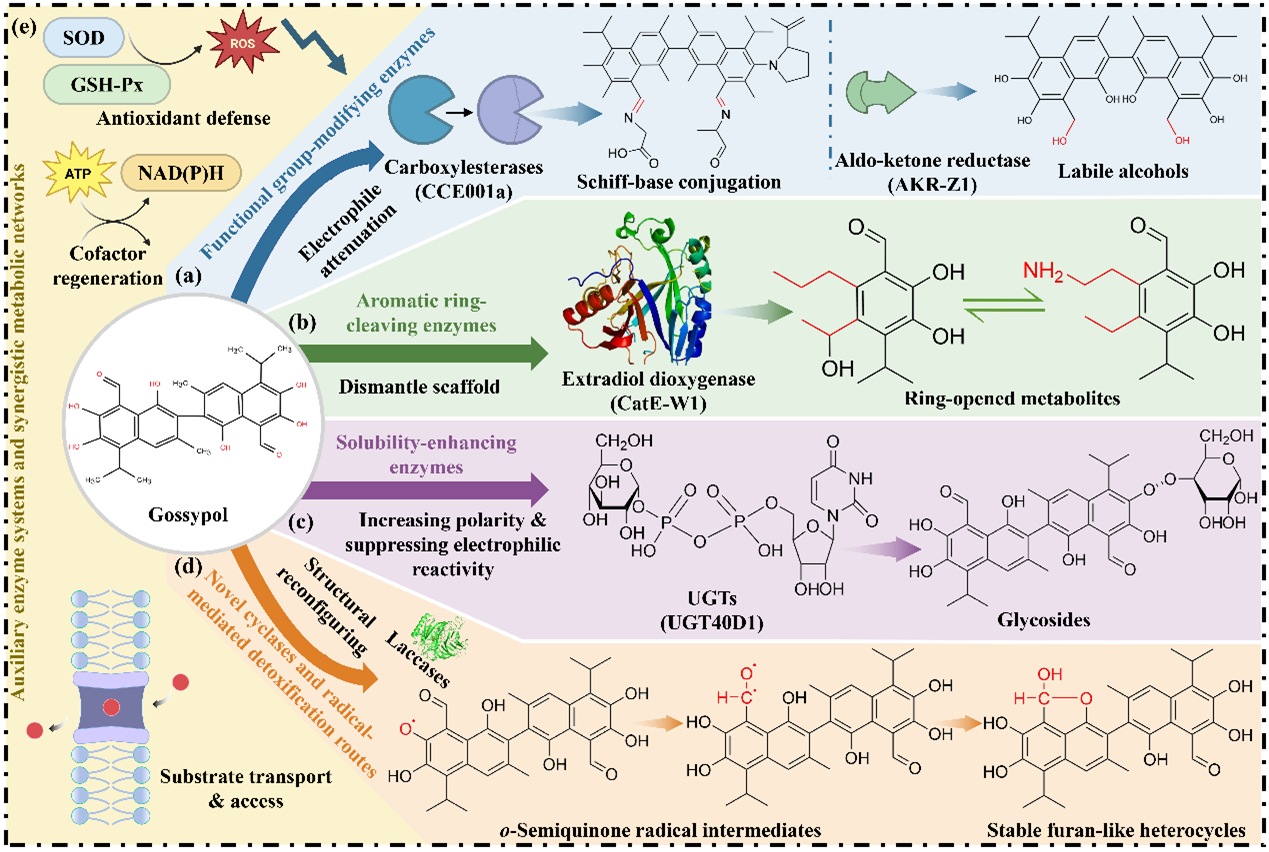
The team systematically reviewed the structural features, toxicological mechanism, and biological detoxification pathways of gossypol. The study showed that the aldehyde group, phenolic hydroxyl group, and binaphthyl scaffold of gossypol jointly determine its protein-binding capacity, redox activity, and multi-organ toxicity. Meanwhile, free gossypol and bound gossypol can undergo dynamic interconversion, and a decrease in their total content does not necessarily equate to a reduction in toxicity. Based on this, the team proposed a systematic biological detoxification technology framework encompassing microbial degradation, enzymatic transformation, enzyme engineering, multi-enzyme cascades, and synthetic biology, and established reliable evaluation criteria for green detoxification. This work, entitled"Biological Detoxification of Gossypol: Enzymatic Mechanisms, System Engineering, and Prospects for Green Valorization", was published in Journal of Agricultural and Food Chemistry (CAS Q1 Top Journal, IF = 6.2). Dr. Pei Xiaodong, a young faculty member from the College of Food and Bioengineering, is the first author; Wu Bohan, a 2025-entrymaster's student, is the second author; Professors Wei Tao and Zhang Xiao are the corresponding authors; and ZZULI is the first affiliated institution. Journal article link: https://pubs.acs.org/doi/10.1021/acs.jafc.5c17645.
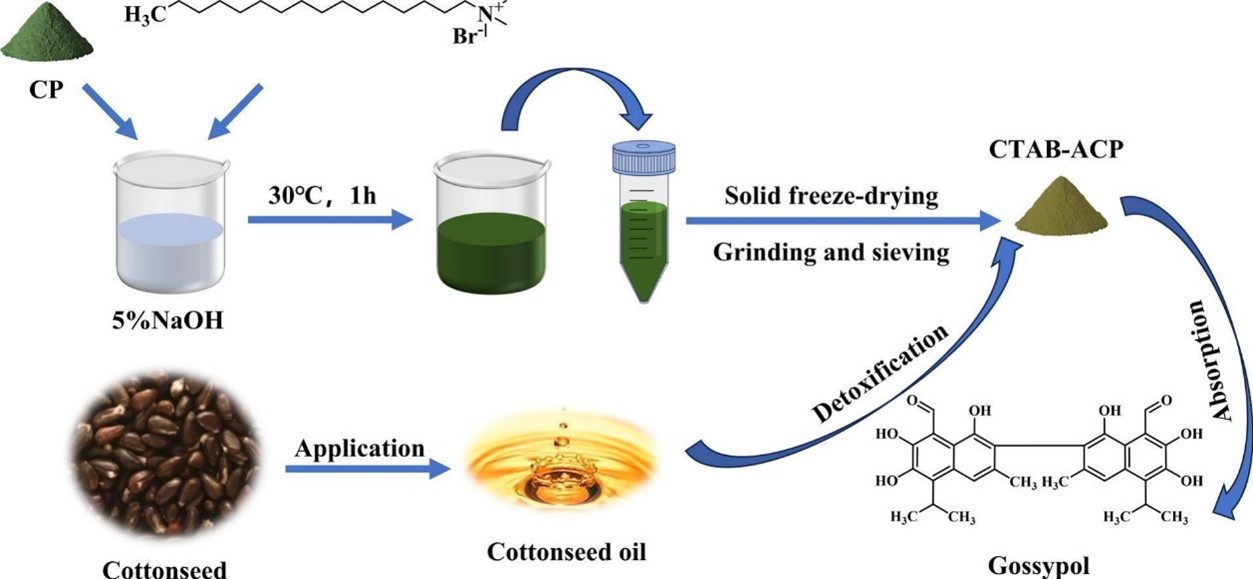
Building on the theoretical mechanistic studies, the team developed a novel bio-based adsorbent for the removal of gossypol from cottonseed oil. The composite adsorbent CTAB-ACP was fabricated from Chlorella pyrenoidosa (CP) biomass as the feedstock, modified with cetyltrimethylammonium bromide (CTAB). The material combines surface functional groups of microalgae with hydrophobic molecular adsorption capacity, enabling effective capture of gossypol in the oil phase. Experiments showed that under the conditions ofCTAB-ACP dose of 16%, temperature at 35°C, and adsorption time of 8 h, CTAB-ACP achieved a gossypol removal rate of 90.8% and an adsorption capacity of 67.55 mg/g, exerted minimal impact on oil quality, and retained over 50%removal efficiency after four reuse cycles. The related work, entitled"The removal of gossypol from cottonseed oil by Chlorella pyrenoidosa modified with cetyltrimethylammonium bromide", was published in Food Chemistry (CAS Q1 Top Journal, IF = 9.8). Zhang Mengdi, a 2023-entrydoctoral student from the College of Food and Bioengineering, is the first author; Professors Wei Tao and Zhang Xiao are the corresponding authors; and ZZULI is the first affiliated institution. Journal article link: https://doi.org/10.1016/j.foodchem.2026.149815.
The above-mentioned results were funded and supported by the Key R&D and Promotion Program of Henan Province (Grant No.: 231111111700).