| [栏目图片] |
Research Team Led by Professor Zhang Zhihong from the College of Material and Chemical Engineering Publishes the Latest Review in Coordination Chemistry Reviews |
|||
|
|
|||
|
|||
|
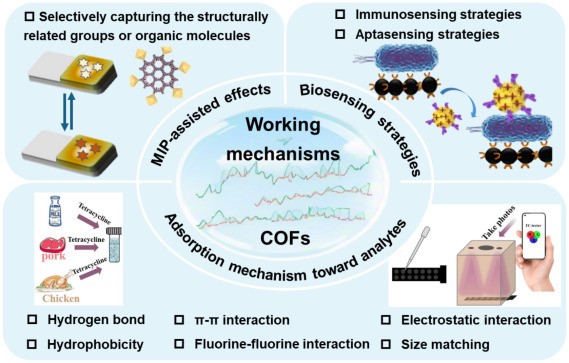
Recently, the research team led by Professor Zhang Zhihong from the College of Material and Chemical Engineering published a review entitled "Precision design of crystalline COF nanoplatforms: Revolutionizing biosensing paradigms in agri-food quality control and safety assurance" in Coordination Chemistry Reviews (Chinese Academy of Sciences Q1 TOP journal, IF = 23.5), an influential and authoritative international review journal in the chemistry field. Dr. Guo Chuanpan from the College of Material and Chemical Engineering serves as the first author, and master's degree candidate Li Wenqi as student first author. Food safety is critical for both public health and sustainable economic development. Typically, there is a wide spectrum of potential contaminants related to food safety, including antibiotics, pesticides, heavy metal ions, mycotoxins, organic pollutants, and foodborne bacteria. In light of this, the development of advanced detection technologies for the precise and sensitive identification of such contaminants in food and the environment holds paramount importance. This review summarizes recent progress and current situation of covalent organic frameworks (COFs) in detecting food contaminants in complex environmental and food matrices. It elaborates on the structural features and classification of COF-based nanomaterials, and clarifies the relationship between the structural design of COFs and their sensing performance. Additionally, the adsorption mechanisms and biosensing principles of COF-based sensors for detecting food contaminants are discussed, along with a summary of various detection techniques. Finally, the review not only identifies the challenges and future prospects for food contaminant detection technologies, but also provides a clear path for researchers to transform molecular design into practical applications. These research efforts will inject fresh impetus into the development of next-generation precision-targeted COF-based sensors and the enhancement of food safety monitoring. This research was supported by the Program for Innovative Research Team in Science and Technology in Universities of Henan Province (Grant No. 25IRTSTHN003), the Natural Science Foundation of Henan Province (Grant Nos. 232300420384 and 242300421634), and the Henan Province Science and Technology Program for Tackling Key Problems(Grant Nos. 242102230001 and 242102241037). Journal article link: https://doi.org/10.1016/j.ccr.2025.216862 |
|
Copyright © 2014 Zhengzhou University of Light Industry, China. All Rights Reserved. Add: No.136 Ke Xue Avenue,Zhengzhou,HenanProvince,PRC. Zip Code:450000 It is recommended that you use IE7 and above version of the browser to visit the web site. |