| [栏目图片] |
Associate Professor Zhang Qi from the College of Energy and Power Engineering Publishes a Research Paper in Chemical Engineering Journal |
|||
|
|
|||
|
|||
|
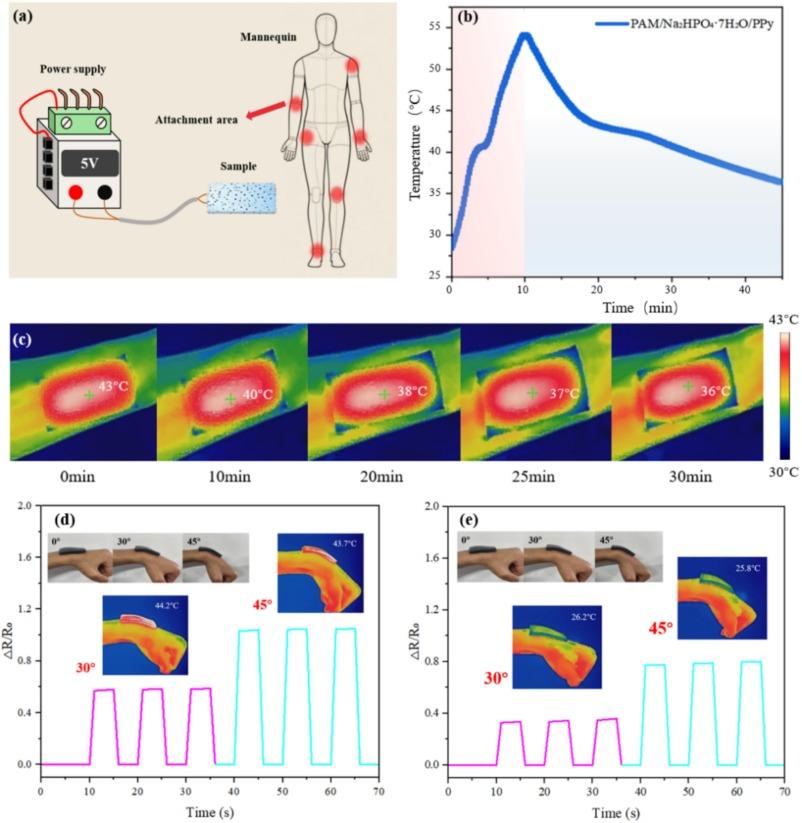
Recently, Associate Professor Zhang Qi from the College of Energy and Power Engineering at Zhengzhou University of Light Industry (ZZULI) published a high-level research paper titled "Double-crosslinked phase change hydrogel with superior electro-thermal conversion efficiency and piezoresistive properties for smart healthcare applications" in Chemical Engineering Journal (CAS Q1 TOP journal, IF=13.4). Associate Professor Zhang Qi serves as the first author and corresponding author, and ZZULI is the first affiliated institution. Although conventional inorganic hydrated salt phase change materials (PCMs) feature high thermal energy storage density and desirable phase change temperatures, they suffer from leakage, high rigidity and single functionality. These limitations make them unsuitable for smart wearable medical devices requiring flexibility and multifunctional integration. To address these challenges, the research team innovatively designed and fabricated a novel PAM/Na₂HPO₄·7H₂O/PPy phase change hydrogel (PCH) with a dual-crosslinked network. Hydrophilic polypyrrole (PPy) nanoparticles, fabricated via chitosan surface functionalization, not only serve as hydrogen-bonded physical crosslinking points with the polyacrylamide (PAM) network but also establish three-dimensional thermally and electrically conductive pathways. This significantly enhances the shape stability, mechanical properties, and multifunctional integration capabilities of the composite hydrogel. The results demonstrate that the phase change hydrogel achieves a high encapsulation efficiency of 84.06%, with a phase change enthalpy of 160.3 J·g⁻¹, a peak specific heat capacity of 7.6 J·g⁻¹·K⁻¹, and a 46% enhancement in thermal conductivity. Furthermore, it delivers an electro-thermal conversion efficiency of 91% at a low voltage of 5 V, with a gauge factor (GF) of 2.85 and an elongation at break of 374%. The material can withstand torsional deformation exceeding 180° and can be repeatedly folded, while adhering tightly to diverse surfaces such as the human palm, plastic, and rubber. In a practical application, 18g of the PCH is electrically heated at 5 V for 10 minutes. It subsequently maintains a temperature between 40–43°C for 10 minutes, and then for a further 15 minutes between 37–40°C, yielding a total effective thermotherapy duration of over 25 minutes. Simultaneously, whether at room temperature or during heat application, the material can monitor resistance changes in real time corresponding to wrist joint flexion angles of 0°, 30°, and 45°. Thus, it realizes an integrated functionality encompassing "electro-thermal driving—precise thermotherapy—joint motion monitoring". This work provides a high-performance material platform for next-generation smart wearable medical devices and holds significant prospects for applications in chronic pain management, sports injury rehabilitation, and electrophysiological signal monitoring. This work has been supported by programs such as the National Natural Science Foundation of China, the Henan Province Key Research and Development Special Project, and the Henan Province Science and Technology Program for Tackling Key Problems. Journal article link: https://doi.org/10.1016/j.cej.2026.176100 |
|
Copyright © 2014 Zhengzhou University of Light Industry, China. All Rights Reserved. Add: No.136 Ke Xue Avenue,Zhengzhou,HenanProvince,PRC. Zip Code:450000 It is recommended that you use IE7 and above version of the browser to visit the web site. |