| [栏目图片] |
Associate Researcher Liu Yaqian from the College of Electrical and Information Engineering and the Academy for Quantum Science and Technology Publishes a Review Paper in the Comprehensive Prestigious Journal Advanced Science |
|||
|
|
|||
|
|||
|
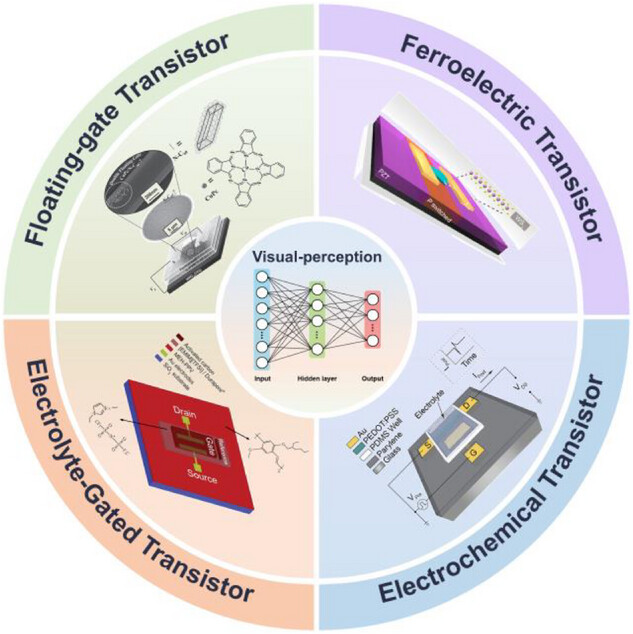
Recently, the research group led by Associate Researcher Liu Yaqian from the College of Electrical and Information Engineering and the Academy for Quantum Science and Technology at Zhengzhou University of Light Industry (ZZULI) published a review paper titled "Recent Advances and Perspectives on Field-Effect Transistors for Artificial Visual Neuromorphic Systems" in Advanced Science(CAS Q1 TOP journal, IF=14.1), a comprehensive prestigious journal. Associate Researcher Liu Yaqian is the first author, Lang Menghua, a 2024 graduate student, is the second author, and ZZULI is the first affiliated institution. Driven by the rapid advancement of AI and machine learning, the conventional von Neumann architecture suffers from severe challenges such as high latency and excessive energy consumption, due to the physical separation between computing and memory units. In contrast, human visual systems provide a crucial model for next-generation intelligent computing by virtue of the integration of storage and computation parallel processing and ultra-low power consumption. The team has systematically reviewed the latest research progress in artificial visual neuromorphic systems based on field-effect transistors (FETs). The review summarizes the material selection, operational principles, and key roles in emulating biological visual functions of various device structures, including floating-gate FETs (FGFETs), ferroelectric FETs (FeFETs), organic electrochemical FETs (OECTs), and electrolyte-gated FETs (EGTs). The research indicates that FET devices, by virtue of their superior optoelectronic tunability, mechanical flexibility, and low-power operation, have emerged as a mainstream platform for constructing artificial visual perception systems, and demonstrated significant potential in tasks such as edge detection, pattern recognition, and multisensory integration. The review offers systematic theoretical guidance and cutting-edge insights for the design of next-generation bio-inspired visual electronics and for overcoming the von Neumann bottleneck. This research has been supported by the National Natural Science Foundation of China and other projects. Journal article link: https://doi.org/10.1002/advs.202518193 |
|
Copyright © 2014 Zhengzhou University of Light Industry, China. All Rights Reserved. Add: No.136 Ke Xue Avenue,Zhengzhou,HenanProvince,PRC. Zip Code:450000 It is recommended that you use IE7 and above version of the browser to visit the web site. |