| [栏目图片] |
Associate Researcher Wang Yan from the School of Electrical and Information Engineering and the Academy for Quantum Science and Technology Publishes a Research Paper in the Top-Tier International Journal Nature Communications |
|||
|
|
|||
|
|||
|
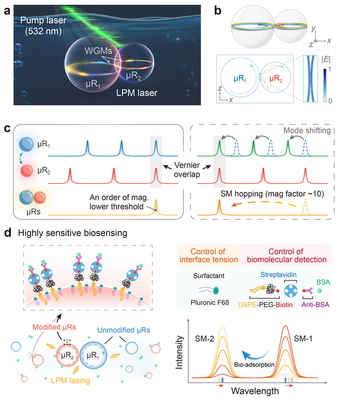
Recently, the research group led by Associate Researcher Wang Yan from the School of Electrical and Information Engineering and the Academy for Quantum Science and Technology at Zhengzhou University of Light Industry (ZZULI) published a high-level research paper titled "Liquid photonic-molecule microlasers for ultrasensitive biosensing" in the top-tier journal Nature Communications (CAS Q1, TOP journal, IF=15.7). Associate Researcher Wang Yan is the first author, and Hu Yuhao, a 2023 graduate student, is the second author.ZZULI is the first affiliated institution. With features of excellent reconfigurability, high sensitivity to environmental stimuli and label-free biosensing ability, droplet microlasers present significant application prospects in biophotonics. However, conventional droplet microlasers suffer from drawbacks such as poor spectral purity, high lasing thresholds, and restricted sensitivity and limit of detection. This study first proposes the concept of Liquid Photonic Molecule (LPM) and constructs a new type of droplet microlaser by optically coupling two size-mismatched dye-doped oil droplets in an aqueous environment. The study finds that by effectively suppressing non-overlapping resonant modes via the spectral Vernier effect, this device enables single-mode lasing with a low threshold of approximately 610 nJ/mm². Using a photoisomerizationstrategy, the dynamic tunability of the single-mode laser is achieved, with a nearly 10-fold enhancement in spectral sensitivity compared with the conventional single-droplet system. More importantly, the study establishes a novel self-referenced detection mechanism based on the laser mode intensity ratio, with the detection limit of biomolecular sensing as low as 30 aM and a dynamic range over 9 orders of magnitude. Two detection indicators demonstrate a three-orders-of-magnitude enhancement compared with those of the conventional single‐droplet system. The study bridges the research gap between microcavity photonic devices and optofluidic biosensing, and also offers new insights for the advancement of droplet optomechanics, hybrid droplet metasurfaces, and non-Hermitian droplet photonics. This research has been supported by the National Natural Science Foundation of China, the Natural Science Foundation of Henan Province, and the Quantum Science and Technology Innovation Team. |
|
Copyright © 2014 Zhengzhou University of Light Industry, China. All Rights Reserved. Add: No.136 Ke Xue Avenue,Zhengzhou,HenanProvince,PRC. Zip Code:450000 It is recommended that you use IE7 and above version of the browser to visit the web site. |