| [栏目图片] |
Dr. Li Guopei from the College of Energy and Power Engineering Publishes a Research Paper in International Renowned Journal Water Research |
|||
|
|
|||
|
|||
|
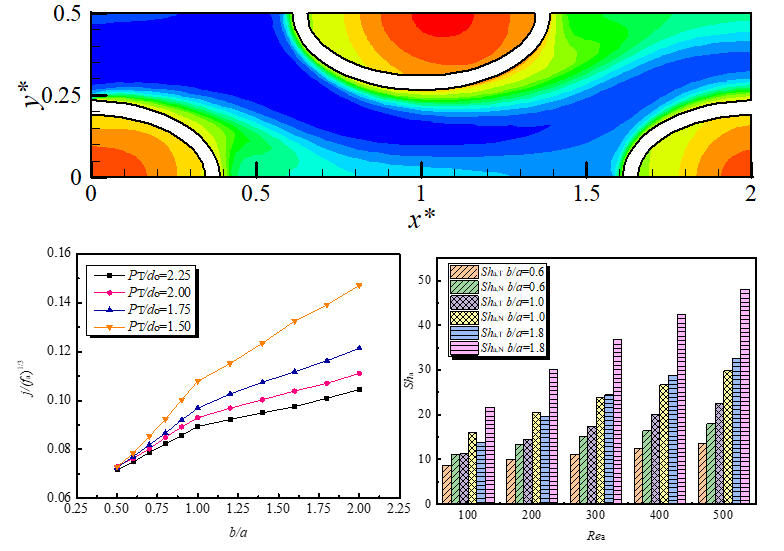
Recently, Dr. Li Guopei from the College of Energy and Power Engineering at Zhengzhou University of Light Industry (ZZULI), in collaboration with Professor Lin Lu from The Hong Kong Polytechnic University, published a high-quality academic paper titled "Coupled heat and moisture transfer in elliptical semi-permeable membrane fiber bundles for membrane distillation desalination" in Water Research (CAS Q1 TOP journal, IF=12.4), an international prestigious journal. Dr. Li Guopei serves as the first author, and ZZULI is the first affiliated institution. Hollow fiber membrane module (HFMM) serves as an effective heat and moisture exchanger in membrane distillation desalination. To address the elliptical deformation with equal perimeter during the processing of fiber tubes and the low-Reynolds-number turbulent phenomena in cross-flow configurations, this study establishes a low-Re k-ε turbulence model. Specifically, this study employs the model to analyze the effects of varying air Reynolds numbers and elliptical fiber semi-axial ratios on the flow fields, turbulent kinetic energy fields, temperature fields, and concentration fields of both the solution and air inside the membrane module. Results show that the airflow fields in tube bundles significantly affect the temperature fields and concentration fields, and the cross-membrane heat transfer between air and solution is more pronounced than the cross-membrane moisture transfer. This study compares the calculated values of heat and mass transfer criterion numbers under coupled heat and mass boundary conditions and conventional constant wall temperature boundary conditions, finding that the coupled heat and mass boundary conditions can significantly improve the prediction accuracy of the turbulent mass transfer performance of an elliptical HFMM. Therefore, the overall heat and mass transfer performance of the membrane module is effectively enhanced by increasing the elliptical semi-axial ratio of the fiber tube cross-section and reducing the spacing between fiber tubes. These research findings are of significant guidance for the design and optimization of HFMM. This research has been supported by programs such as the National Natural Science Foundation of China, the Henan Province University Science and Technology Innovation Talent Program, the Henan Province Science and Technology Program for Tackling Key Problems. Journal article link: https://doi.org/10.1016/j.watres.2025.124942 |
|
Copyright © 2014 Zhengzhou University of Light Industry, China. All Rights Reserved. Add: No.136 Ke Xue Avenue,Zhengzhou,HenanProvince,PRC. Zip Code:450000 It is recommended that you use IE7 and above version of the browser to visit the web site. |